
Portable Power Stations: Watts, Runtime & Recharge

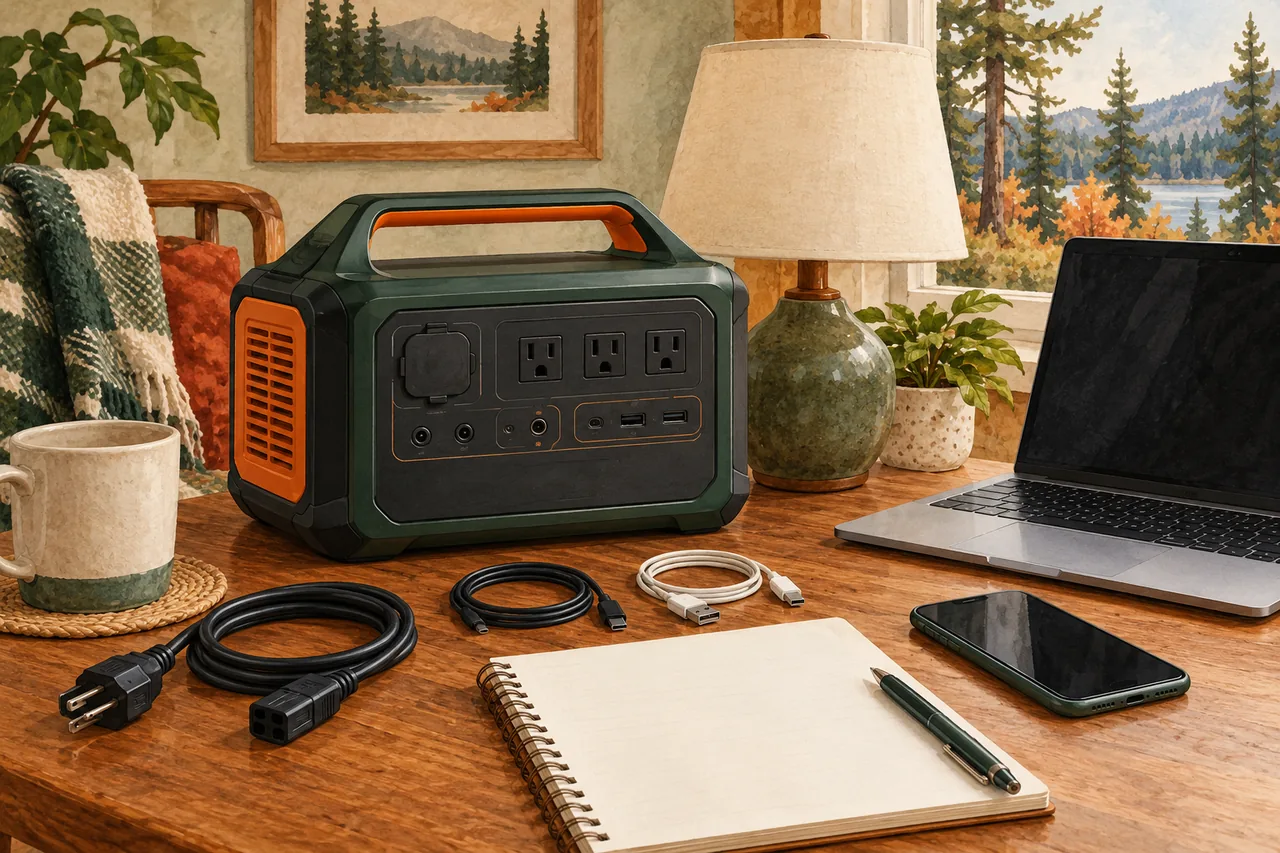
Portable power stations are easiest to compare when you separate two questions: can the unit run your equipment, and can it run that equipment for long enough? A large output rating answers neither question on its own.
Start with the appliances you need, the length of the interruption you want to cover and a realistic way to recharge.
Choose a specific use case before choosing a battery. A laptop used away from an outlet, a refrigerator during a short outage and a household circuit backup system need different checks.
Buying for every imagined emergency can leave you with an unnecessarily heavy unit and accessories you never use.
Start with these three checks
- Separate device power demand from energy capacity.
- Check output limits in each operating mode.
- Plan when and how you will recharge.
Portable power stations: watts are not watt-hours
Watts describe power; watt-hours describe an amount of stored energy. The Jackery HomePower 3600 Plus manual illustrates the distinction with a 3,600-watt rated AC output and 3,584-watt-hour battery capacity.
Those are different specifications, despite the similar numbers. Neither is a promise of a particular appliance runtime.
For your shortlist, ask for a runtime estimate based on the actual equipment and operating pattern. Note whether the estimate includes inverter losses, the station’s own consumption and a remaining-charge reserve.
A refrigerator cycles; a heater may draw power continuously. An estimate based on a different operating pattern can look precise while answering the wrong question.
Compare the capacity of the base unit separately from any expanded configuration. Check how many additional batteries the manufacturer supports, which connecting accessories are required and what the advertised package actually includes.
Do not assume a photo of several batteries describes the contents of the box.
Check output in each operating mode
List each appliance’s supply voltage, normal demand and any starting requirement. Confirm the limits of individual outlets as well as the station’s total output. A compatible-looking plug does not establish that a particular appliance combination will work.
Ask the supplier to identify the relevant manual specification rather than offering a blanket compatibility assurance.
Pay close attention to bypass and backup modes. Jackery’s manual gives the HomePower 3600 Plus a lower output limit in bypass mode than its rated battery-powered output. It also says the product does not provide zero-millisecond switching and warns against connecting equipment that requires uninterrupted power.
Read those restrictions before treating any transfer-time claim as a substitute for application approval.
If backup power supports medical equipment, ask the equipment manufacturer and your care provider to approve the complete arrangement. This guide cannot establish medical suitability. For computers or other interruption-sensitive equipment, confirm the required power quality and transfer behavior with the equipment supplier.
Plan the next recharge before buying more capacity
Ask how you will recharge after the first discharge. If your plan depends on a working household outlet during a grid outage, it does not yet cover an extended interruption.
Compare the manufacturer’s permitted charging methods and input limits against the sources you can actually access.
A solar bundle needs more scrutiny than the combined panel wattage. The Jackery manual states that solar charging time depends on weather. Ask for the exact panel models, station input requirements, cables and allowed configuration.
A larger panel label does not guarantee faster charging if the station or configuration limits the input.
Keep several use patterns separate when requesting estimates: charging with loads off, charging while appliances operate and operating from the battery alone. Ask whether those modes change the available output or recharge time.
That question often reveals a more useful difference between models than a headline fast-charge claim.
On a small screen, swipe or scroll the table to compare all columns.
| Your main use | Prioritize | Confirm before buying |
|---|---|---|
| Working away from outlets | Manageable weight and suitable device ports | Your device’s charging requirements and expected workday demand |
| Essential-appliance backup | Output compatibility and a realistic energy budget | Appliance starts, operating pattern and acceptable interruption |
| Longer off-grid stays | A dependable recharge plan | Exact solar compatibility and weather-dependent expectations |
| Household circuit backup | A complete approved system | Professional assessment of transfer equipment and installation |
Find a suitable place for the battery
Do not infer weather resistance from a camping photo. The HomePower 3600 Plus manual describes the unit as not waterproof or dustproof and requires protection from rain and humid conditions.
Follow the exact station’s environmental and ventilation instructions; do not apply one manufacturer’s requirements to every product.
Before choosing a heavy unit, check the route between storage and use, including stairs and vehicle loading. Look at the manual’s handling and transport requirements. Decide who can move it safely and whether an expansion battery makes the arrangement impractical.
A portable label does not mean every household member can lift the product.
Read battery care and charging warnings before purchase. Jackery instructs users to stop using a damaged product and not to open, repair or modify it. Confirm how the manufacturer handles service, storage and end-of-life recycling.
Keep charging accessories matched to the product rather than treating an adapter that fits as approval.
Make the shortlist specific
Browse Patioora portable power stations with a written equipment list. Request the exact manual, base capacity, required accessories and current package contents for each candidate. For a connection to household wiring, use a qualified electrician and manufacturer-supported transfer equipment; never feed power through a household wall outlet.
Frequently asked questions
Will more output watts give me a longer runtime?
Not by themselves. Compare stored energy and the equipment’s energy use separately from output capability. Ask for a runtime estimate tied to your load rather than a generic number of hours.
Is a solar generator ready to make power without panels?
Check the package contents. The term can describe a battery station sold with compatible panels, but a product name alone does not confirm included panels or cables. Request the itemized bundle.
Can every station replace an uninterrupted power supply?
No. Check the manual’s transfer behavior, bypass limits and equipment restrictions. The Jackery example expressly excludes equipment requiring zero-interruption power; other models need their own compatibility checks.