
Solar Panels & Kits: Compatibility & Site Checklist

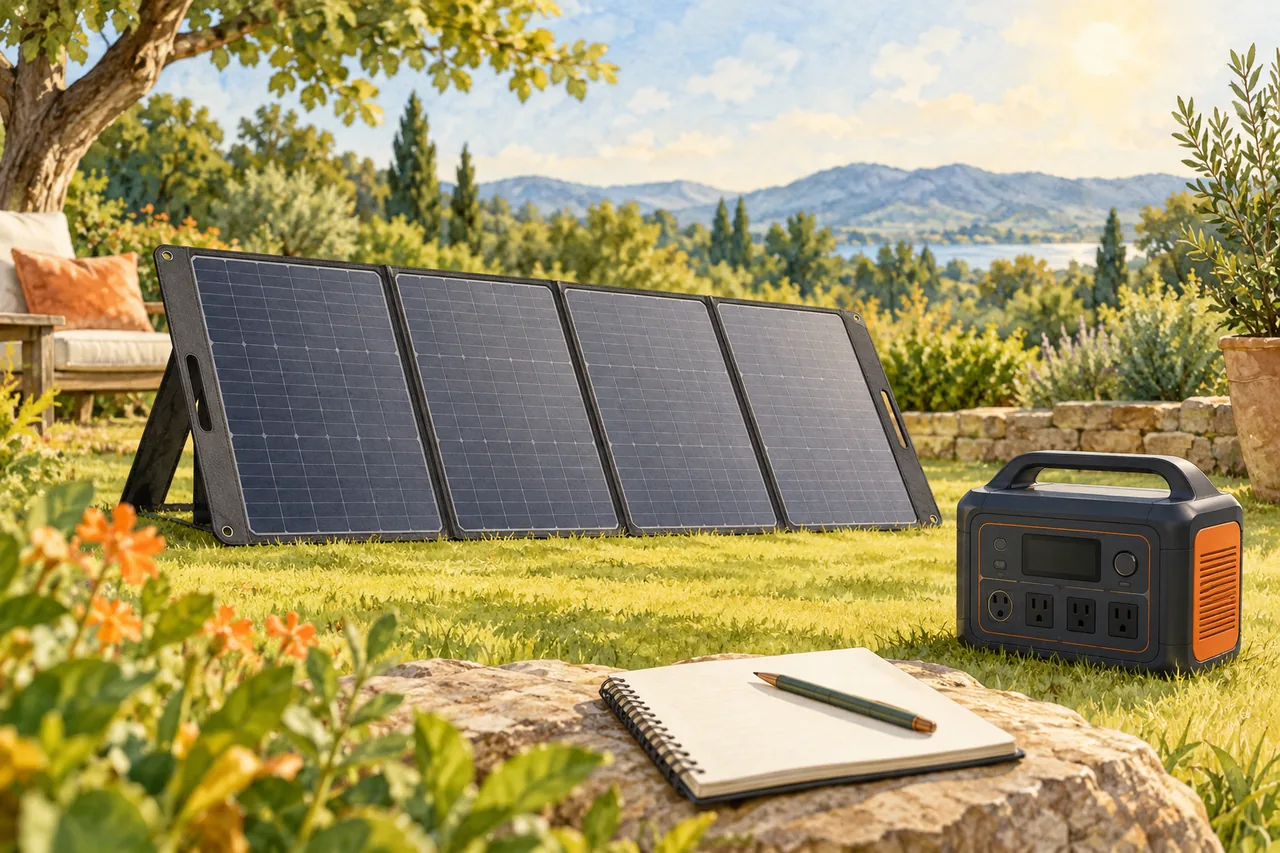
Solar panels and kits can solve very different problems. One kit may charge a portable battery; another may feed electricity into a grid-connected home. Before comparing panel wattage, decide whether you want daytime generation, stored energy for later or backup during an outage.
Those goals do not describe the same system.
For a compact home kit, start with the complete equipment list and the intended connection method. A listing described as a plug-in solar kit still needs a location-specific assessment.
Do not assume that a familiar plug, a small system size or a manufacturer’s overseas installation example settles what is permitted at your property.
Start with these three checks
- Identify whether the system is portable or fixed.
- Check panel, controller and battery compatibility.
- Review site conditions and required approvals.
Solar panels and kits: identify the system type
A panel bundle with a grid-connected microinverter should not be treated as a portable battery charger. The APsystems EZ1 consumer guidance describes the EZ1 as grid-tied and says it will not produce power when the grid is down.
If outage support is your main goal, ask for an explicitly designed backup system rather than assuming panels alone will keep household equipment running.
Ask the seller to identify the exact inverter version and market. APsystems publishes different regional documents. Its North American EZ1-LV manual, revision 1.2 dated October 13, 2026, is the relevant regional reference for that model.
Similar product names do not make regional electrical specifications interchangeable. The manual says only qualified professionals should install or replace the microinverters.
Make your purchase brief specific: the country and utility service, the proposed site, your daytime electricity use and whether storage is required. Ask the supplier to confirm which products meet that brief.
Leave wiring design and commissioning to a qualified solar professional and the relevant approval process.
Check compatibility beyond panel watts
Record the panel nameplate capacity separately from inverter output. Ask what each number describes, what operating conditions apply and whether the inverter limits the available output. Do not turn the combined panel rating into a guaranteed household power supply or annual energy figure.
Request the panel and inverter datasheets together. Have the professional reviewing the project confirm electrical compatibility, including the relevant voltage and current limits. For an APsystems package, use the documentation for the actual regional model, available through the APsystems US document library.
A matching connector appearance is not a compatibility assessment.
Then ask what is missing. A useful quote identifies panels, inverter, mounting equipment, cables, any required safety equipment and the scope of professional work. Ask which components are included in the advertised kit and which belong in the installed project.
Do not let the word complete replace an itemized bill of materials.
Assess the site before estimating savings
Prepare photographs and notes for a solar professional, including the proposed mounting surface, nearby obstructions and access constraints. The US Department of Energy homeowner solar guide explains that site conditions, shade and roof characteristics affect a solar project’s suitability.
A remote product recommendation is not a structural or electrical inspection.
If the proposed location is a balcony, fence, patio cover or outbuilding, ask specifically whether the mounting method and supporting structure are suitable. Do not attach panels to a convenient surface merely because the kit fits there.
The manufacturer, structural reviewer and local authority may each have requirements that affect the choice.
Request a production estimate for the actual location and orientation, with its assumptions written down. Compare that estimate with your household’s daytime use and the applicable utility arrangement.
Avoid a savings calculation based only on panel wattage, an ideal sunny day or another customer’s electricity rate.
Ask about approvals before placing the order
APsystems’ US consumer guidance tells buyers to check with the local authority having jurisdiction before a permanent wall-outlet connection. Ask a qualified electrician and your utility what the proposed system requires at your address.
This guide does not authorize plugging a generation source into an existing household receptacle.
Request written confirmation of the applicable interconnection, permitting and inspection steps. Also check property-owner or association approval where relevant. Do not rely on another state’s program, a European balcony-solar example or a sales description as proof that the same arrangement is allowed locally.
On a small screen, swipe or scroll the table to compare all columns.
| Decision | Question to settle | Evidence to keep |
|---|---|---|
| System purpose | Daytime grid-connected generation or a storage/backup project? | A description of supported operating modes |
| Regional suitability | Is this the correct inverter and documentation for the property? | Exact model label and applicable manual |
| Panel compatibility | Has the complete configuration been checked? | Panel and inverter datasheets reviewed together |
| Mounting and access | Can the structure support the proposed installation? | A site-specific professional assessment |
| Permission to connect | What does the utility and local authority require? | Applicable approvals and inspection scope |
Choose a kit you can document and maintain
Ask who handles a failed panel, inverter problem or monitoring issue. Keep the separate component warranty documents and clarify labor coverage rather than assuming one kit warranty covers every part of the project.
Request instructions for owner checks and a safe service route without opening electrical equipment.
Use Patioora solar panels and kits as a starting point for a documented comparison. Confirm the exact offer and regional model before purchase. If the site, approvals or system purpose remain unclear, resolve those questions before choosing extra panel capacity.
Frequently asked questions
Will a grid-tied kit work during a blackout?
Do not assume so. APsystems says the EZ1 does not produce power when the grid is down. Ask for a system specifically designed for backup operation if that is your goal.
Does plug-in mean no electrician or approval is needed?
No. Confirm the proposed connection with a qualified professional, the utility and your local authority. Product capability is not the same as permission to use a particular connection at your address.
Can I compare kits by total panel wattage alone?
No. Compare the inverter, panel compatibility, mounting scope and expected production for your site as well. Ask for an itemized quote and a written explanation of the proposed system.