
Vehicle Horns & Accessories: Fitment Before You Buy

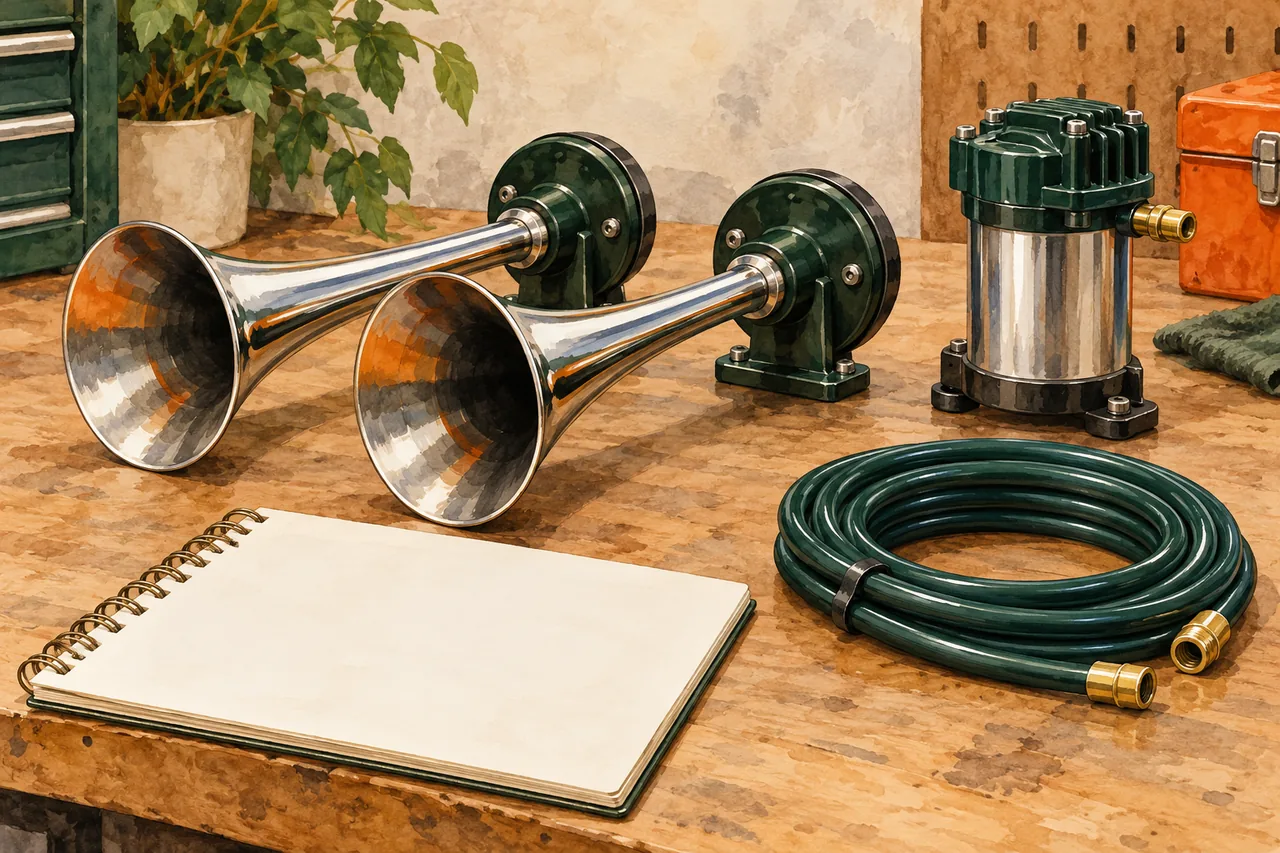
A vehicle horn kit is easy to judge by sound and much harder to judge by fit. Photographs rarely show the clearance around the installed assembly, the components supplied in the box or what happens to the factory spare tire.
Before comparing vehicle horns and accessories, decide what you want to change and whether the proposed system can be installed and used appropriately on your vehicle.
This is a purchase guide, not a wiring or air-system installation tutorial. It does not establish that an aftermarket horn is legal for a particular road, vehicle or location.
Check applicable requirements with the relevant authority and have a qualified installer assess the exact equipment before committing to a kit.
Start with these three checks
- Confirm fitment for the exact vehicle and mounting location.
- Request a complete included-parts list.
- Check installation needs and applicable sound restrictions.
Define the purpose of vehicle horns and accessories
Write down whether you need an appropriate replacement for an existing horn, a separate accessory system or a mounting component for a kit you already own. Those are different purchases.
A bracket listing is not automatically a complete horn system, and a complete kit description should still identify each included component.
For road-going use, ask whether the proposed change is permitted and whether the required original warning equipment must remain functional. Do not rely on a seller’s broad street-legal statement without vehicle- and location-specific confirmation. This guide intentionally gives no universal legal conclusion.
If the intended purpose is simply to make the vehicle more noticeable, consider the consequences of unintended or inappropriate activation before considering a louder accessory. More sound is not evidence of a safer outcome.
Avoid treating social-media demonstrations, recorded audio or decibel headlines as a useful substitute for a fitment and safe-use review.
A spare-tire mounting system changes the space you own
HornBlasters’ Spare Tire Delete kit documentation describes a system occupying the factory spare-tire location and warns that fitment is not universal. The manufacturer also says the pictured assembly arrives as components requiring assembly.
Those are important distinctions when a photograph makes the package look ready to install.
Record the vehicle’s year, make, model and relevant configuration. Ask the supplier and installer to confirm the exact bracket and kit version against that vehicle, including any fitment notices.
A statement that a bracket fits most pickups is not confirmation that it fits your truck.
Decide what will happen to the spare tire before ordering. Ask whether the proposed alternative storage or roadside plan is practical for your use of the vehicle. Do not treat removing a spare as an invisible consequence of adding an accessory.
That decision can be more important to daily ownership than the appearance of the horn assembly.
Have the installer assess the complete location, including clearances and the manufacturer’s mounting requirements. Do not infer safe clearance from an unloaded vehicle photograph. This is a reason for professional inspection, not an invitation to fabricate a different bracket or bypass required restraints.
Check the complete parts list
An air-horn system can involve horns, a compressor, receiver, valve, lines and electrical controls. The HornBlasters Conductor’s Special 232 instructions identify a specific system arrangement. Use the manual supplied for the exact purchased configuration rather than assuming every product carrying a similar kit name has identical parts.
Request the current itemized contents and part numbers. Ask which mounting hardware, electrical protection and controls are included and which are additional requirements. Keep the quote and the manual revision together.
If the seller’s contents list and manufacturer documentation disagree, resolve the difference in writing before purchase.
This matters for replacement parts too. A familiar family name is not enough to order a compressor or pressure-control component. Supply the existing component identification and ask for an approved replacement.
Do not substitute parts based on appearance, an apparently larger pressure rating or an assumption that all kits in the family use the same configuration.
Leave electrical and compressed-air installation to qualified hands
The manufacturer’s Spare Tire Delete instructions include specific mounting and electrical provisions. Obtain a complete installation assessment instead of treating those requirements as optional accessories. Ask the installer to identify the applicable manual, required protection and maintenance access before agreeing to the work.
Do not bypass pressure controls, substitute unapproved electrical protection or modify a receiver to make a kit fit. A purchasing guide cannot size wiring or validate a pressure-system modification remotely.
If the supplied system cannot be installed as documented on the vehicle, choose a supported alternative rather than planning an improvised conversion.
Discuss service access while the installation is still a proposal. Ask how the documented inspections and maintenance will be performed and which components need accessible locations. A tidy installation is not enough if routine checks become impractical or the owner cannot identify the equipment afterward.
On a small screen, swipe or scroll the table to compare all columns.
| Decision | Evidence needed | Stop if |
|---|---|---|
| Vehicle fit | Written match to vehicle and kit version | The answer is only fits most trucks |
| Package completeness | Itemized current contents and manual | The photo is the only parts reference |
| Installation | Qualified assessment of documented requirements | The plan relies on bypasses or improvised pressure parts |
| Use | Applicable requirements and manufacturer warnings | Safe and permitted operation cannot be established |
Ownership includes the sound risk
HornBlasters’ Conductor’s Special 232 product warnings require hearing protection and caution against operation near living beings or in a closed environment. Read the complete warnings for the exact system.
Do not test a high-output horn indoors, beside people or animals, or for surprise reactions.
Recorded demonstrations cannot establish what the equipment will sound like in your setting. Nor should quoted loudness values from different listings be ranked without knowing the measurement conditions. Ask about the system’s safe-use restrictions before treating a sound claim as a feature.
- Confirm intended use and applicable local requirements.
- Record vehicle details and obtain exact fitment approval.
- Resolve spare-tire storage if the mounting system displaces it.
- Match kit contents and manual revision to the quoted configuration.
- Arrange qualified installation, service access and a safe-use plan.
Use Patioora’s vehicle horns and accessories category to identify candidates, then request the missing documentation. A complete answer about fit and responsible use is worth more than a dramatic sound description.
Frequently asked questions
Does a complete kit fit every vehicle?
No. Complete describes the supplied package, not universal vehicle compatibility. Confirm the particular vehicle, bracket and kit version before ordering.
Can a spare-tire delete kit keep the spare in its original position?
The referenced mounting system uses the spare-tire location. Resolve an appropriate alternative plan before purchase and confirm the actual arrangement with the installer.
Are louder horns automatically suitable for public roads?
No. Loudness does not establish permission or suitability. Check applicable requirements and the manufacturer’s warnings for the exact system and intended use.