
Portable Sheds: Storage Space & Access Checklist

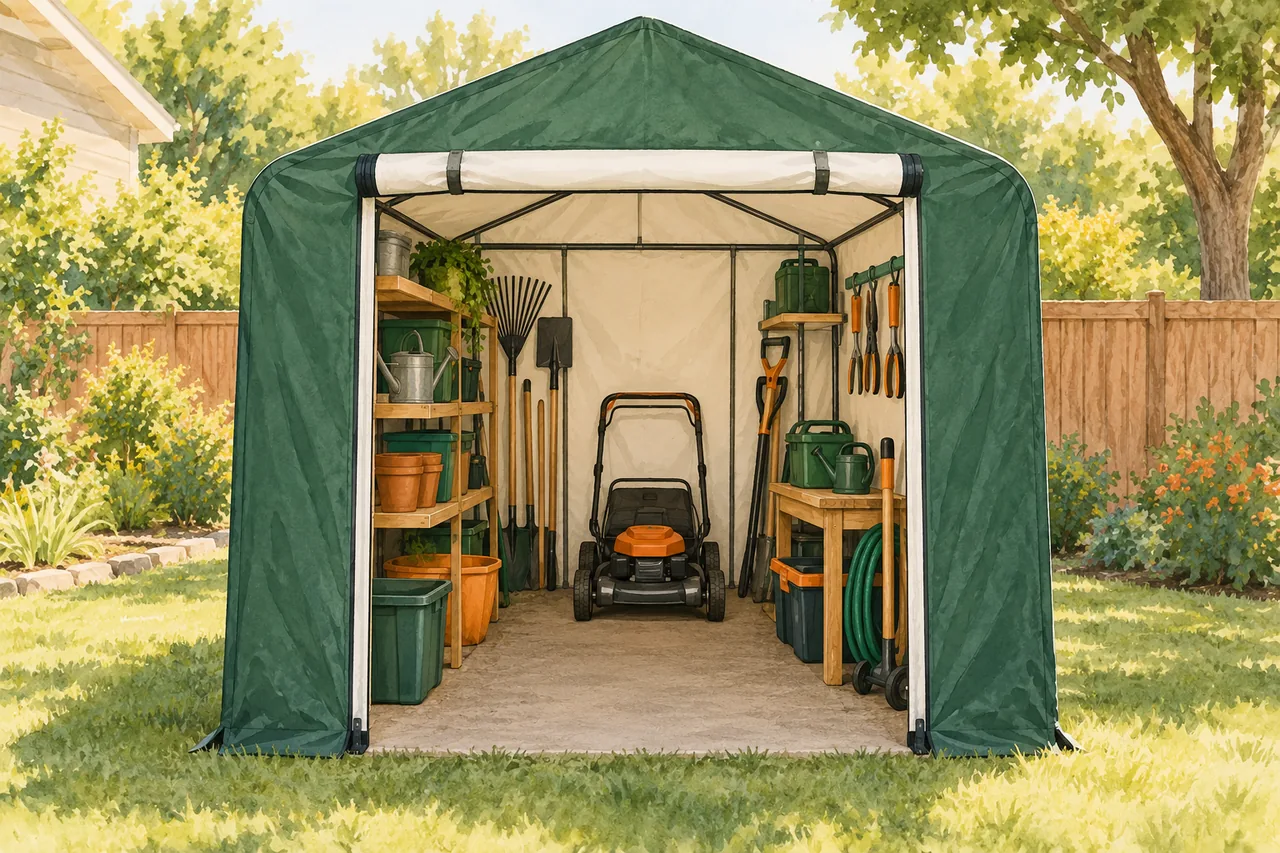
A Shed-in-a-Box or similar portable shed is worth considering when you need covered equipment storage and can meet the exact model’s installation and care requirements. Choose the door opening and a workable storage layout before choosing floor area.
If you need secure, conditioned storage or a permanent building, make those requirements explicit before comparing fabric shelters.
A mower that fits inside but cannot turn through the doorway is still a storage problem. So is a shed packed tightly enough that every trip requires unloading half the contents.
This buying guide starts with the equipment you actually use and works outward to the shelter.
Start with these three checks
- List the largest items you need to store.
- Plan a route from the doorway to each item.
- Read moisture and maintenance instructions.
Know what Shed-in-a-Box means
Shed-in-a-Box is a ShelterLogic product family, not a general specification for every portable shed. The manufacturer’s family page describes a steel frame, a polyethylene cover and a zippered door arrangement.
Select the actual model and consult its documents rather than assuming all sizes share the same opening or supplied components. Read the Shed-in-a-Box family information.
Separate the description of the cover from your expectations for the whole storage space. A manufacturer’s waterproof-cover claim is not a promise that belongings will remain dry regardless of ground moisture, open doors or condensation.
Ask what the complete kit includes, which floor or base provisions it requires and which storage uses the manufacturer approves.
Also check the product’s intended status. For example, ShelterLogic’s model 70403 manual labels that specific Shed-in-a-Box a temporary structure. That does not mean installation requirements are optional or that it can be left unsecured because you plan to move it. See model 70403’s manual and safety information.
Build the storage list before the shopping list
Divide your belongings into items that move often and items you rarely touch. Put the mower, bicycles or frequently used garden cart in the first group. Put empty planters or seasonal furniture in the second.
Then decide which items you would be comfortable storing in an unconditioned fabric shelter at all.
For equipment, use the maker’s storage instructions. Do not assume a shelter makes it acceptable to store any fuel, chemical or battery in any condition. If an item needs controlled temperature, restricted access or another special provision, resolve that independently.
A portable shed should not be sold to yourself as a substitute for conditions the item requires.
Measure the largest object in the condition in which it will actually enter. Fold a handle only if that is a task you are willing and permitted to do each time.
Include bags, handles, mirrors and attachments. Keep those dimensions next to the candidate shed’s clear door dimensions, not its roof dimensions.
A portable-shed decision table
On a small screen, swipe or scroll the table to compare all columns.
| Storage task | What to check | Buying mistake to avoid |
|---|---|---|
| Rolling in a mower | Clear door opening and approach | Comparing only the nominal shed width |
| Taking out bicycles daily | Unobstructed route to the door | Filling the access route with seasonal boxes |
| Keeping bulky furniture | Actual item layout and handling space | Assuming the entire footprint can be packed solid |
| Storing moisture-sensitive belongings | Item storage requirements and shelter conditions | Treating a covered roof as humidity control |
| Possible future relocation | Manufacturer disassembly and reinstallation guidance | Assuming portable means assembled transport |
Draw a route through the shed
Sketch the largest items first, followed by the walking and handling routes. Try taking the mower out on paper without moving the stored furniture. If the plan fails, choose a different arrangement or reconsider the size.
Do this before buying shelving, since shelves can consume the space you intended to use for maneuvering.
Do not plan to hang storage from the frame unless the manufacturer expressly approves the accessory and load for that model. Instead, ask which storage arrangements are permitted and include any freestanding storage footprint in your sketch.
This avoids inventing useful space above or beside the equipment.
Now check the approach outside the door. Include a garden gate, a narrow side passage and the place where you will stand while opening the entrance. Choose a location you can reach with the loaded cart, not merely one where the shelter’s outline fits.
Ask about moisture before you move belongings in
ShelterLogic explains condensation as moisture forming when humid air meets a cooler surface. Its Arrow-building guidance also discusses drainage and airflow. Use that explanation to ask about the planned storage environment, not to transfer an Arrow installation method to a fabric shed or promise condensation-free storage. Read ShelterLogic’s condensation guidance.
Ask the supplier or installer how the selected model’s instructions address the proposed ground surface, moisture and ventilation. Have them review a location where water already collects rather than trying to solve that problem with a new cover.
This article does not prescribe a floor build-up, vapor barrier installation or drainage construction.
Be selective about what goes inside. If you would be upset to find an item exposed to variable humidity, check its own storage requirements before using an unconditioned shelter. Reserve a more suitable storage environment for items whose requirements cannot be met.
Buy with a realistic care plan
Read the safety and maintenance pages before you decide. Model 70403’s manual requires secure anchoring and regular checks of the cover’s tension; it also warns that the fabric is flammable and must not be exposed to flame sources.
These are that manual’s requirements, not a universal anchoring method or an invitation to carry out structural work from a blog.
Ask how you will identify a replacement cover and obtain the correct part if needed. Keep the model number, receipt and manual in one place. Do not budget around an invented cover lifespan: choose based on documented care requirements, your exposure and what the manufacturer can confirm.
- Verify the exact clear opening against the largest object.
- Keep a usable route to frequently accessed equipment.
- Confirm the model’s site, anchoring and maintenance requirements with a competent installer.
- Check permissions rather than assuming temporary storage is exempt.
- Keep a record of the correct cover and replacement-part identifiers.
The storage sheds category is a starting point for comparing storage approaches. Check each individual product’s construction and requirements rather than treating every shed as the same environment.
Frequently asked questions
Does a portable shed need anchoring?
Follow the exact model’s manual and have the site requirements reviewed. Model 70403 explicitly requires secure anchoring. The word portable does not establish that an unsecured shelter is safe, and included components do not settle suitability for every ground condition.
Will a waterproof cover keep everything inside dry?
Do not read a cover description as a guarantee for the entire storage environment. Consider condensation, ground conditions and how you use the doorway. Check the stored items’ requirements and ask the supplier what the selected shelter can reasonably provide.
Should I buy the largest portable shed that fits?
Choose enough usable space for your planned items and access routes, subject to site suitability. A larger footprint alone does not fix a small doorway, an awkward approach or an unsuitable storage environment. A measured layout is more useful than area alone.