
Portable Garages: Vehicle Fit & Ownership Guide

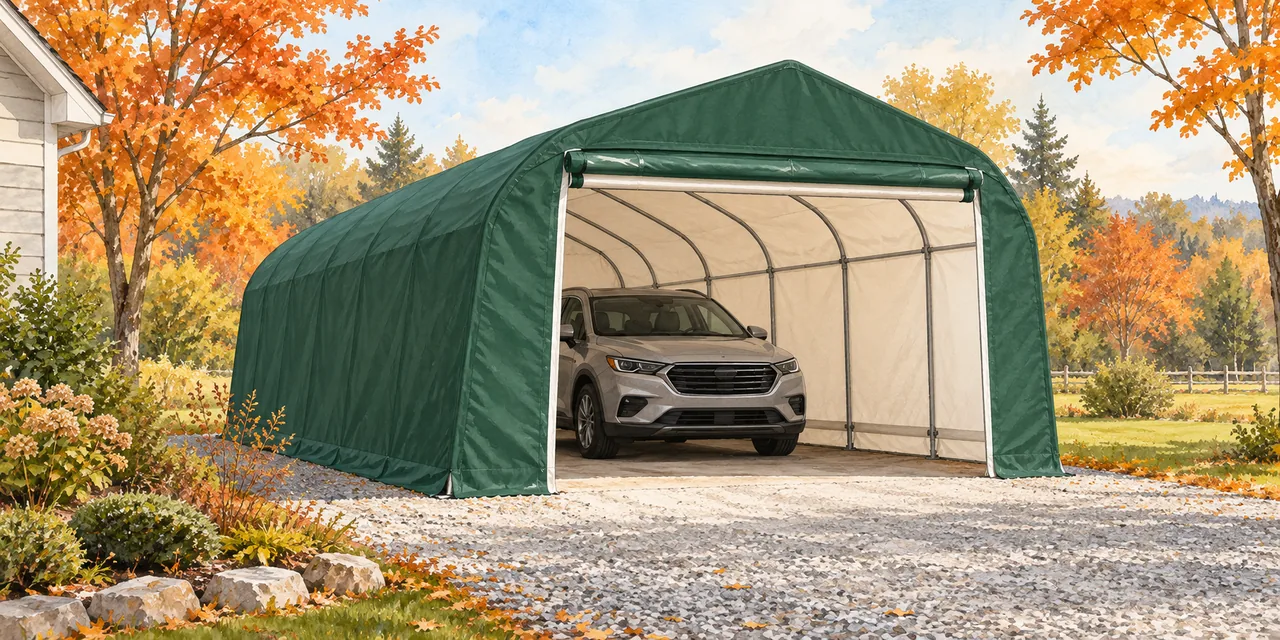
Choose a portable garage by the clear doorway, the space you need around the parked vehicle and the care requirements of the exact shelter. Then confirm site suitability and permissions.
Do not assume a portable garage provides the security, temperature control or documented performance of a permanent building just because both can enclose a car.
Daily parking and occasional vehicle storage create different demands. A shelter that works for a seldom-used trailer may become frustrating if you open its door twice a day and squeeze past the car each time.
Decide how you will use it before comparing size labels.
Start with these three checks
- Measure the entrance as well as the roof height.
- Check the exact weather and care documentation.
- Plan everyday access and ventilation questions.
Portable garages are a storage choice, not one specification
ShelterLogic groups several fabric-garage ranges under portable garages. The manufacturer describes products such as Garage-in-a-Box and ShelterCoat within that broader range. That does not make their dimensions, covers or weather documentation interchangeable. See the manufacturer’s portable-garage ranges.
Make your shortlist by exact model and configuration. Save the size, roof shape, entrance arrangement and supplied cover description with each entry. If a product has selectable options, request the document set for your selection, not just a link to a family page.
Keep enclosed rigid buildings separate in the comparison if they also appear under a store’s garage heading. A category is a browsing aid. It is not evidence that two structures provide the same storage conditions, installation requirements or level of access control.
Measure the entrance before the roof
Use the vehicle as it will actually be stored. Measure or confirm its dimensions with roof bars, racks, mirrors and fitted accessories. For a boat, include the trailer and anything that remains attached while stored.
Do not use the car’s catalog body height if a roof box will stay in place.
Ask for the usable entrance drawing, including how the opening changes across its width. Then compare the route into the shelter. A tall point at the center does not prove that a wide, tall load can pass beneath the surrounding frame.
Ask the manufacturer or supplier to resolve unclear clearance information.
Sketch where the driver’s door opens after parking. Include the route to the shelter entrance and the space needed to handle the door or closure. If you plan to charge equipment, connect services or work on the vehicle, get separate confirmation that the proposed use and equipment are appropriate.
Covered parking is not an automatic workshop approval.
Compare portable garages by parking routine
On a small screen, swipe or scroll the table to compare all columns.
| Use | Priority | Question to resolve |
|---|---|---|
| Everyday car parking | Door handling and driver access | Can you enter, park and leave comfortably each day? |
| Boat on a trailer | Complete stored dimensions | Does the full combination fit through the actual opening? |
| Occasional vehicle storage | Inspection and care routine | Who will check the shelter while it is rarely visited? |
| Tall vehicle | Clear opening across the load’s width | Is the quoted height a peak or usable clearance? |
| Items requiring controlled conditions | Storage specification | Does a fabric shelter meet those requirements at all? |
Ask what the weather description actually covers
Request the selected model’s manual and any supporting rating documents. Keep unrated and rated configurations distinct; do not apply a number found on another size or range. Ask a qualified reviewer to assess the documents for your site rather than interpreting a product name as engineering approval.
A useful example of why the manual matters is ShelterLogic’s Garage-in-a-Box RoundTop manual for models 62780 and 62783. It identifies the shelter as a temporary structure and includes safety, anchoring and cover-care requirements.
Read those requirements for those models, not as a universal rule set for all portable garages. Read the manufacturer’s RoundTop manual.
If your property has demanding exposure or weather conditions, ask the supplier which documented configuration merits further review. Do not convert an advertised snow load into a depth of snow or invent a safety margin.
If the required information cannot be supplied, leave the purchase undecided.
Make condensation and ventilation part of the brief
Water inside a shelter deserves investigation rather than an immediate assumption that the roof leaks. ShelterLogic identifies condensation as a concern and addresses moisture in its FAQ. Use that guidance to frame questions for the exact shelter and site; do not treat a general tip as a guaranteed cure. Read ShelterLogic’s shelter FAQ.
Ask how the intended storage conditions compare with the vehicle or equipment manufacturer’s requirements. If a vehicle will arrive wet, explain that routine when discussing suitability. Avoid packing household belongings around it merely because there appears to be spare floor space.
Decide who will notice a problem. An occasional-use shelter at the back of a property needs an inspection plan just as much as one beside the house. Choose a location and routine that let you follow the manufacturer instructions without needing to climb onto the roof or improvise access.
Understand what portable does and does not settle
Do not assume that portability removes the need for permission, a suitable site or the prescribed installation. Before ordering, ask the relevant authority about your proposed structure and location, and obtain any necessary property-owner approval.
This is a verification task, not a claim that a particular rule applies everywhere.
Likewise, included anchors do not by themselves establish that a kit is suitable for your ground. Have a competent installer assess the current manual and the proposed location. This guide does not specify anchor spacing, concrete work or structural modifications.
If relocation is part of the plan, ask for the manufacturer’s disassembly and reinstallation guidance. Confirm the work involved and which components may need replacement. Do not assume that a shelter described as portable can be moved assembled or that moving it will be a one-person job.
Keep the ownership questions beside the specification
- Can you identify the correct replacement cover and door panels by model number?
- Can you meet the exact manual’s inspection and care requirements?
- Does the written quote distinguish the kit from installation and site work?
- Have permissions and the property’s requirements been resolved?
- Does the shelter meet the storage brief without relying on unverified security or weather promises?
Use the garages and carports category to compare storage approaches, then choose by the individual model’s documents and your vehicle’s actual needs.
Frequently asked questions
Can I choose a portable garage by my vehicle’s length alone?
No. Check the clear opening, complete stored height and width, approach and space to exit the vehicle. Roof accessories, a trailer or a wide door-opening routine can change which shelter is workable.
Does portable mean that I can avoid permission checks?
Do not assume that. Confirm the proposed structure and location with the relevant authority and obtain any required property-owner approval. A product description does not determine your property’s requirements.
Can a fabric garage replace a secure permanent garage?
Do not treat them as equivalent. State any access-control, insurance or environmental requirements separately and check whether the proposed product meets them. If those requirements are central, reconsider the storage type before choosing a fabric shelter.