
Snow Blowers: Driveway, Snow & Storage Checklist

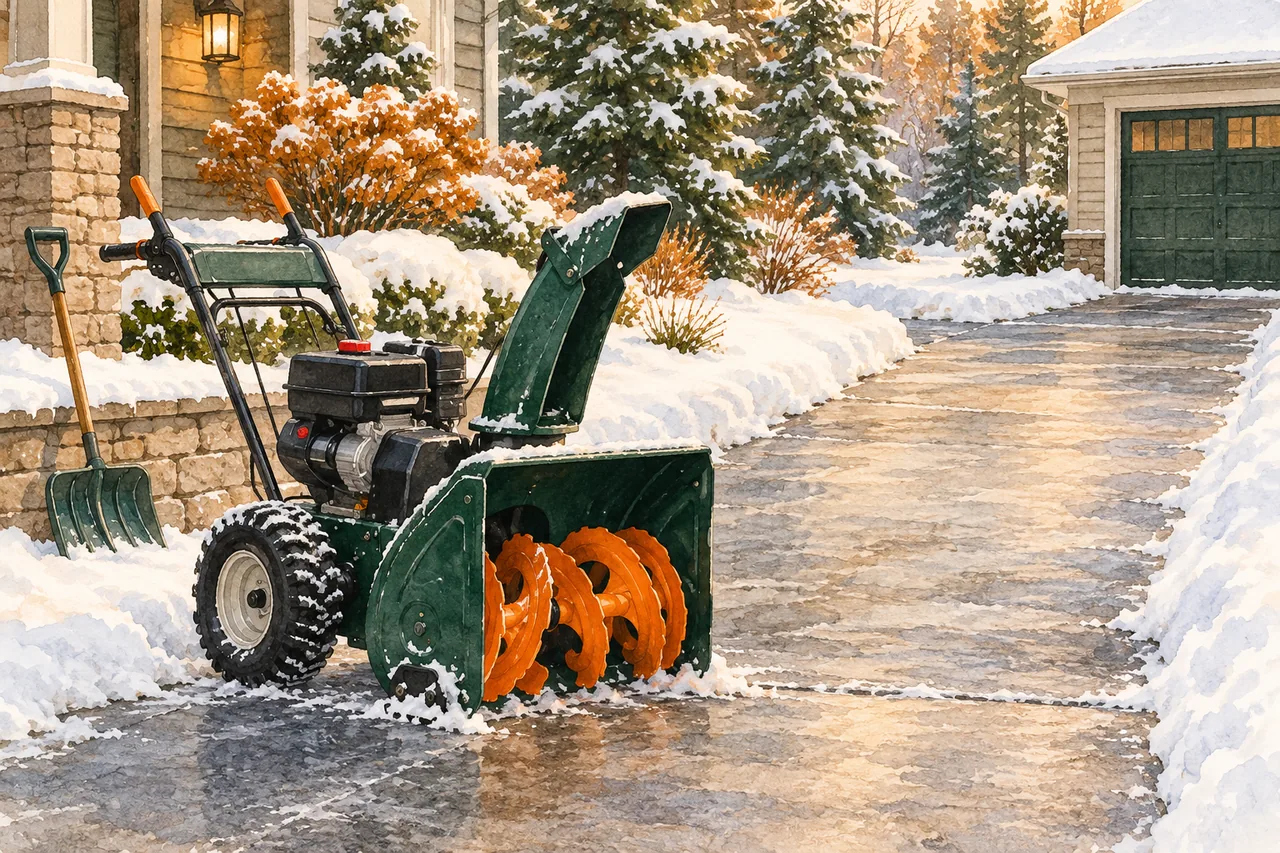
The hardest part of a snow-blower purchase is often deciding which winter to buy for. Most days may bring a modest covering; the storm you remember is the one that left a dense ridge across the driveway entrance.
Compare snow blowers using both your ordinary clearing routine and the difficult conditions you realistically expect, without assuming one headline specification predicts either.
Start with the surface, the route and the operator. Note whether you are clearing pavement or loose material, where the snow can be discharged and how the machine will move between storage and driveway.
Those details can eliminate unsuitable options before you compare engines, batteries or clearing widths.
Start with these three checks
- Record driveway surface and turning space.
- Describe the snow conditions you need to manage.
- Check storage, starting and safe-use requirements.
Choose snow blowers for the ground under the snow
Troy-Bilt’s guide to handling different snow types explains that single-stage machines have an auger that contacts the ground and should only be used on paved surfaces. It distinguishes two-stage machines for heavier, wet snow.
Use those distinctions to begin the search, then read the instructions for the specific model rather than applying a blanket rule to every machine in a stage category.
If you have a gravel or loose-surface driveway, ask the manufacturer which models, if any, it permits for that application and under what conditions. Do not assume adjustable parts make any snow blower appropriate.
This buying guide does not give skid-shoe settings or other setup dimensions; the correct instructions belong to the selected machine and surface.
Walk the clearing route before snowfall and note edges, transitions and objects that could disappear under a white covering. That map helps you explain the property to a dealer.
It also exposes awkward spots where a different clearing method or qualified help may be more sensible than forcing the whole property into one equipment choice.
Describe snow conditions without chasing a universal depth rule
Tell the supplier whether your usual problem is light snow, dense wet accumulation or compacted material left at the entrance. Ask about the exact machine’s intended conditions and limits.
Avoid turning a single advertised snowfall depth into a promise about every type of snow.
Ariens’ explanation of chute clogging identifies heavy, wet snow as a clogging factor. That is useful context for choosing equipment, not a reason to push a machine beyond its instructions.
Ask how the proposed model is intended to handle your conditions and what the operator should do when the machine cannot process them normally.
Think about timing too. Can you usually clear during a long snowfall, or do you return to an accumulated driveway after work? Explain that routine. It is more useful than describing only the largest storm you have ever seen, and it may change which machine is practical to own and store.
Allow room to turn, maneuver and store
Check overall width, not only clearing width, against gates and the storage route. Allow for the space you need to turn without depending on a particular number of advertised passes.
Parked vehicles, walkways and narrow corners can make a larger machine inconvenient even when the open driveway looks generous.
Ask to review the controls and prescribed handling method with the machine safely inactive. Can the intended operator reach and operate the controls while wearing suitable winter gloves?
Does the documented transport and storage arrangement work with your doorway? If it must cross steps, do not assume a heavy machine can simply be carried; resolve a manufacturer-approved plan first.
Review terrain restrictions in the exact operator’s manual. Do not treat powered wheels, tracks or a steering feature as a guarantee of safe operation on your slope or icy surface. If the property falls outside the instructions, another clearing arrangement is needed.
Power source and starting are separate purchase decisions
Identify the actual power source from the model documentation. An electric-start feature on a gasoline machine is not the same as battery propulsion or battery-powered snow clearing. Do not infer how the machine runs from the words electric start in a product name.
For a battery machine, check which batteries and charger are included, which combinations the manufacturer approves and its charging and storage instructions. For an engine-powered machine, read the engine and machine documentation together and plan the required fuel and maintenance arrangements.
Neither option removes the need to understand its safety instructions.
Ask the supplier to explain runtime or clearing claims in their stated conditions. A comparison is not useful if one figure describes light snow and the other has no stated test conditions.
Record missing context instead of turning advertising language into an estimate for your driveway.
On a small screen, swipe or scroll the table to compare all columns.
| Property issue | What to compare | What not to assume |
|---|---|---|
| Smooth paved walkway | Approved surface use and maneuvering | That the widest machine is easiest to use |
| Loose-surface driveway | Explicit manufacturer permission | That every two-stage machine is suitable |
| Frequent wet accumulation | Documented application and controls | That all snow of equal depth behaves alike |
| Tight storage | Overall and stored dimensions | That clearing width describes the footprint |
Make safety part of the purchase, not an afterthought
Read the exact machine’s shutdown and obstruction instructions. The Ariens Deluxe Series operator’s manual 05135700D directs the operator to stop the engine, remove the key and wait for moving parts to stop and hot parts to cool before using the clean-out tool.
It explicitly prohibits using hands. This is a reference example, not a universal operating procedure or a claim about Patioora inventory.
Ask where the required clean-out tool is stored and how to obtain the correct replacement if needed. Review discharge controls and the manufacturer’s precautions for nearby people and property.
A buying decision should leave you with a machine you can use within its instructions, not one that needs improvised workarounds.
- Record surface type, access and usual snow conditions.
- Confirm intended use and terrain limits in the exact manual.
- Check handling, storage dimensions and discharge controls.
- Verify power source, included equipment and maintenance needs.
- Read shutdown and clean-out instructions before the first snowfall.
Compare candidates in Patioora’s snow blowers category using that property brief. Do not select by clearing width until the surface and operating match are settled.
Frequently asked questions
Can I use a single-stage snow blower on gravel?
Troy-Bilt says its single-stage type should only be used on pavement because the auger contacts the ground. For loose surfaces, obtain explicit guidance for the exact model you are considering.
Does electric start mean the snow blower is battery powered?
No. Check the documented power source. A gasoline machine can have an electric-start feature without using electricity to perform the clearing work.
Should I choose solely by snowfall depth?
No. Surface, snow density, access, handling and model limits also matter. Explain your usual conditions and routine to the supplier rather than relying on one advertised depth.