
LED Mirror or Medicine Cabinet? A Bathroom Fit Guide

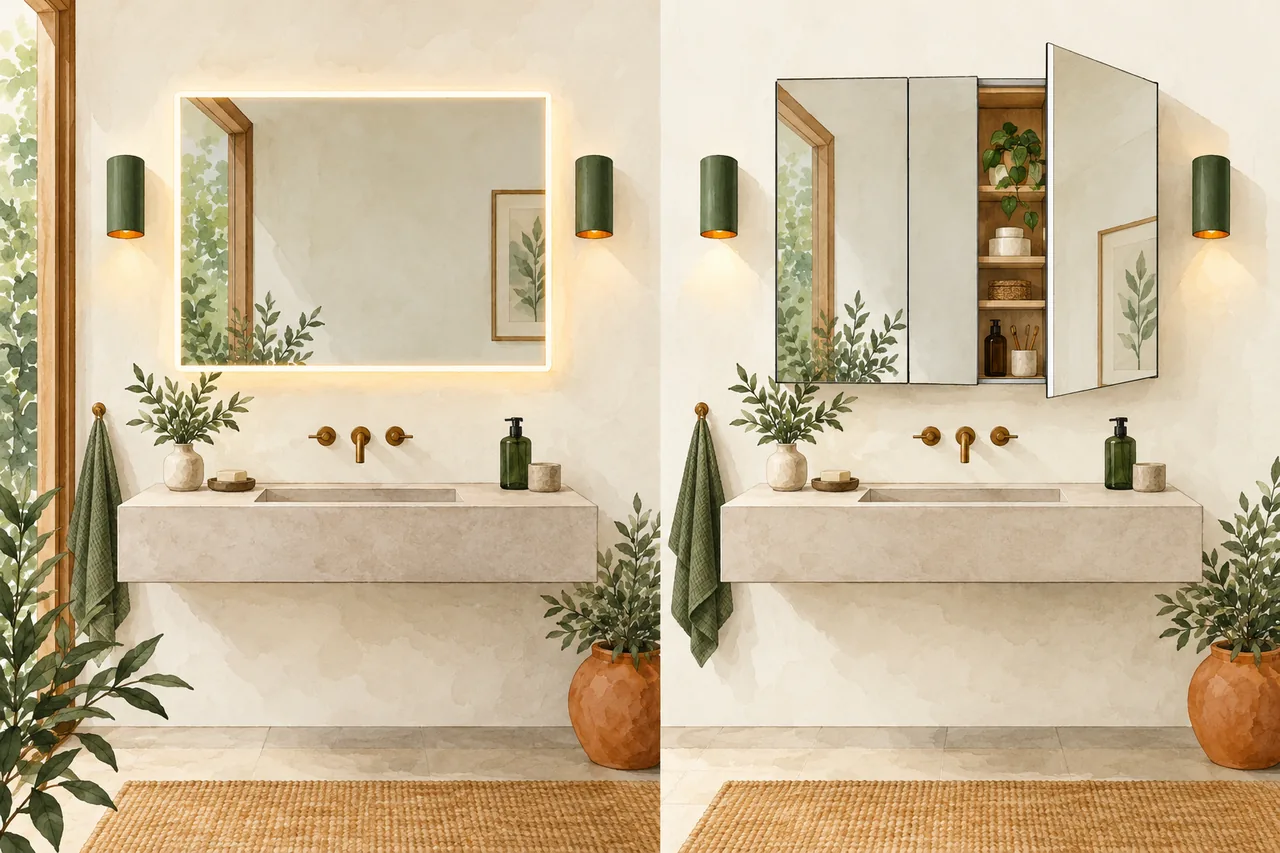
Bathroom planning · Compare the options
Choose an LED mirror when your storage is already covered; choose a medicine cabinet when you need accessible storage at the sink. Compare the lighting, mounting method and door movement separately.
A glowing border in a photograph does not tell you how well the product will light your face or whether its cabinet can fit your wall.
The best choice often starts with the things sitting beside your basin. If the counter is crowded because everyday items have nowhere to go, another mirror will not solve that problem.
If your vanity already holds everything, a cabinet may add depth and installation work you do not need.
Start with these three checks
- Decide whether you need concealed storage.
- Compare lighting features for your routine.
- Confirm wall fit and electrical requirements.
Choose storage or a simpler wall profile
List the items you reach for at the sink and decide which should be visible, concealed or stored elsewhere. Check their heights against the cabinet’s usable shelf spacing.
An interior photograph is helpful, but a dimensioned drawing is better when a particular bottle or electric grooming tool needs to fit.
Think about how you will use the door, too. A left-hinged cabinet and a right-hinged cabinet can behave very differently beside a wall, sconce or second mirror. On a wider cabinet, review each door’s swing and handle access.
Do not assume the hinge direction can be reversed after purchase.
A flat mirror avoids cabinet-door movement, but it still needs a suitable mounting position and power arrangement if it is illuminated. Compare the whole bathroom wall rather than treating the mirror as an isolated rectangle above the sink.
Judge the light by the task
Decide whether you want the mirror to support shaving, makeup, general grooming or mostly softer evening light. Ask for the exact model’s light output, color-temperature options and dimming method.
Confirm whether published figures describe the whole fixture or a particular setting. Avoid comparing products using a single number with no explanation.
Consider the existing ceiling lights and sconces as part of the plan. A bright ceiling can still leave shadows where you do not want them, while a decorative backlit edge may not provide the effect you expect for close work.
Ask for a demonstration or an honest description of the light distribution rather than relying on an edited room photograph.
Check whether controls remember their last setting and how the unit behaves when the room switch is used. These are practical questions for anyone who wants the bathroom to feel consistent each morning.
Treat every feature as unconfirmed until it appears in the documentation for the selected model.
Mounting is a wall decision, not just a style choice
A recessed cabinet sits partly within the wall; a surface-mounted cabinet projects into the room. The cleaner-looking option in a photograph may not suit the existing wall construction.
Ask a qualified installer to assess the proposed location before committing to a mounting method.
Give that professional the exact cabinet drawing, not only its front dimensions. Pipes, wiring, structural elements and the wall assembly can affect feasibility. This is not a reason to open the wall yourself.
Electrical work and any structural changes need appropriately qualified professionals.
The Krugg Svange 2430 installation and user guide illustrates both recessed and surface mounting. It also prohibits an outside dimmer for that model. These are model-specific details, not permission to use either mounting method or control arrangement with every Svange cabinet.
Ask your installer to obtain the current instructions for your exact unit.
A comparison sheet that catches expensive mismatches
On a small screen, swipe or scroll the table to compare all columns.
| Decision | LED mirror | Medicine cabinet |
|---|---|---|
| Daily storage | Plan storage elsewhere | Verify usable interior and shelf spacing |
| Room projection | Check fixture depth | Check mounted depth and door swing |
| Wall suitability | Confirm support and power location | Confirm support, recess feasibility and power |
| Lighting controls | Read the model’s instructions | Read the model’s instructions |
| Shared use | Check viewing area for both users | Check door access for both users |
Mark every unanswered question on the sheet. A product with fewer features but complete documentation may be easier to plan around than one whose description leaves its controls and mounting requirements unclear.
Check the small features against your routine
If a defogger matters, ask where it operates on the glass, how it is controlled and what coverage the manufacturer specifies. Do not assume it clears every part of the mirror.
If the cabinet has internal outlets or charging ports, confirm their intended use and location in the exact documentation.
Consider service access as well as first-day appearance. Ask how a qualified service professional would reach the relevant components if needed. Keep the model number and guide somewhere accessible rather than relying on a listing that may change.
Krugg Svange and Aquadom designs deserve the same careful comparison: look at the exact model, not a feature you remember from another product in the range. Compare the LED Mirrors & Medicine Cabinets category by exact model and ask your installer to review the shortlist before purchase.
LED mirror and medicine cabinet FAQs
Can an LED mirror replace all the bathroom lighting?
Do not assume so. Review its documented output and light distribution alongside the rest of the room. Ask a lighting professional to assess the plan if the mirror will be a major light source.
Can I use my existing wall dimmer?
Only if the exact manufacturer’s instructions permit it and a qualified electrician confirms compatibility. Built-in dimming does not automatically mean a product works with an external wall dimmer.
Is recessed mounting always better?
No. Recessed mounting can reduce projection, but the wall must suit that installation. Surface mounting may be the more practical choice after a professional reviews the wall and surrounding fixtures.