
Cabinet Beds: A Practical Guest-Room Planning Guide

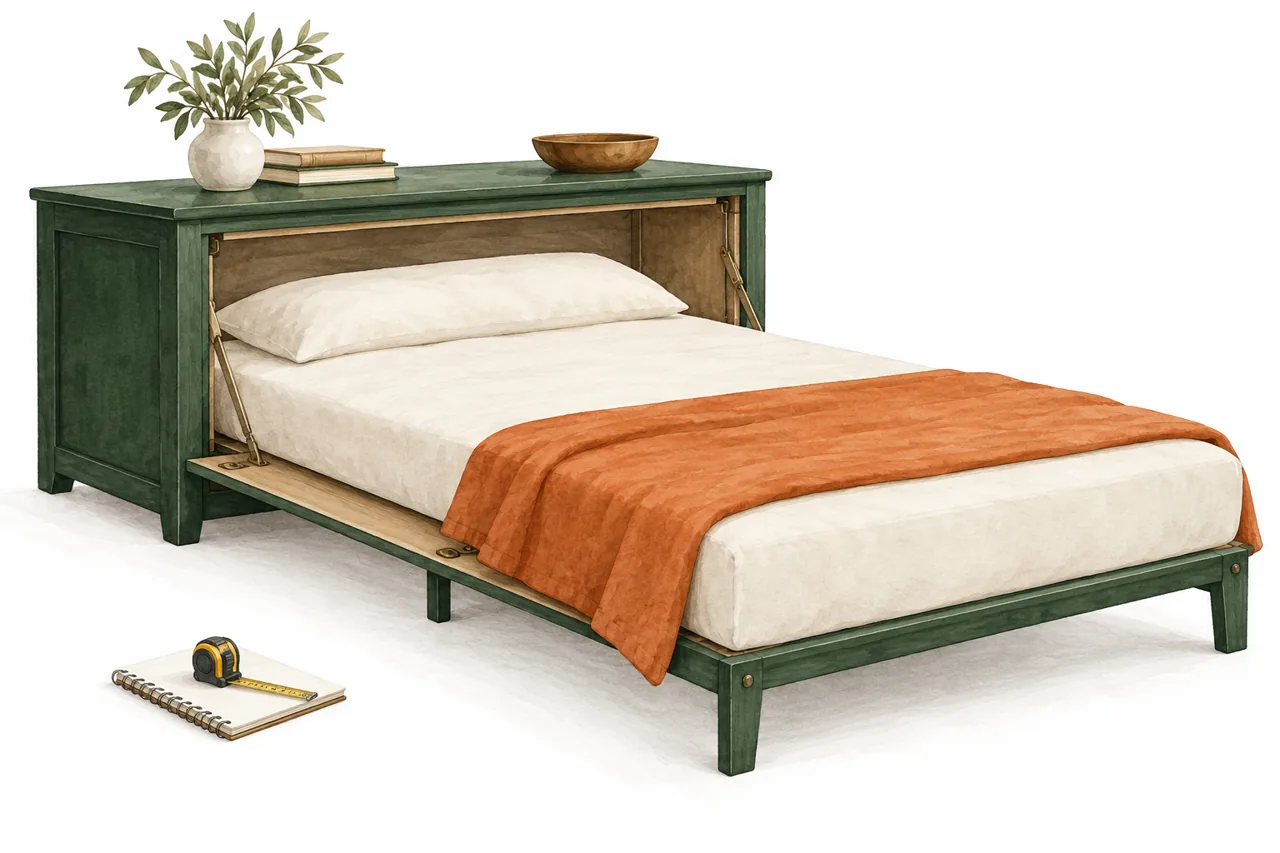
Guest spaces · Everyday room planning
A cabinet bed makes sense when you want a room to work as living space most days and become a guest bedroom when needed. Choose it by testing the complete open layout, the conversion routine and the mattress arrangement.
The closed cabinet’s size is only half the decision.
A home office can look spacious with the bed folded away and become difficult to use once it opens. The useful question is whether someone can arrive, make up the bed and spend the night without moving half the room.
Plan that evening before choosing the cabinet finish.
Start with these three checks
- Draw the room with the bed both open and closed.
- List furniture that must move on guest nights.
- Check the exact mattress and setup requirements.
Draw the room twice
Make one plan for daytime use and another for overnight use. On the daytime plan, show the desk chair, side tables and anything normally stored in front of the cabinet.
On the overnight plan, show the bed fully open, luggage, a bedside surface and a clear route to the door.
Compare the manufacturer’s closed dimensions and open dimensions separately. Check whether the opening sequence needs space beside the cabinet as well as in front of it. A floor rectangle can show where the mattress ends up, but it may not show the movement of panels or supports during conversion.
For a documented example, CabinetBed Inc.’s Barn White page describes a freestanding queen cabinet bed measuring 66.5 inches wide, 25.25 inches deep and 42.5 inches high when closed, opening to 82 inches long.
Those dimensions apply to that product, not all cabinet beds. Confirm the current drawing for the exact model and finish you select.
Mark the proposed bed outline on the floor and walk through the room. Include the door swing and the path to the bathroom. If the arrangement depends on moving a heavy desk every visit, compare another position before assuming the room will work.
Decide what must move on guest nights
Write a conversion list: move the chair, relocate a table, clear the opening area, get the bedding and set up the sleeping space. Keep it realistic. If the person using the bed cannot comfortably perform the documented conversion, plan appropriate help or consider a different arrangement.
A demonstration is more useful than a promised conversion time. Ask to see the complete sequence for the exact model, including how the mattress sits, where the supports go and how the cabinet closes afterward.
Do not use a video of a different mechanism as operating instructions.
Check what may remain on top during use according to the manufacturer’s instructions. Do not assume decorative objects, lamps or electronics can stay there because a lifestyle photograph shows them on the closed cabinet.
Include cable management and breakable items in your planning questions.
The mattress is part of the mechanism decision
Confirm whether the exact package includes a mattress and which replacement mattresses the manufacturer permits. A mattress that fits a conventional queen frame is not automatically suitable for a cabinet bed.
Ask about the required folding arrangement, dimensions and thickness rather than substituting one on size name alone.
Think about the sleeper’s preferences, too. Ask for a clear description of the supplied mattress and its care instructions. If comfort is a major concern, arrange a demonstration or seek more detailed information before purchase.
Avoid inferring firmness from the words “memory foam” or from an image of the cover.
Plan where pillows, sheets and blankets will live. A storage drawer may be useful, but check its usable dimensions and the manufacturer’s instructions about what can stay inside.
Keep a separate bedding location if the cabinet cannot hold everything you intend to use.
A guest-night readiness checklist
- The exact open footprint fits without obstructing the doorway or essential access.
- Any side-panel movement has room throughout the documented conversion.
- The person responsible for opening and closing the bed understands the model’s instructions.
- The selected mattress is included or explicitly compatible.
- Bedding and luggage have a planned location.
- A lamp or bedside surface remains accessible when the bed is open.
- The installation and placement requirements have been reviewed by a qualified furniture installer where appropriate.
Run through the checklist using the room as it is normally lived in. A plan that only works after clearing away everyday equipment is different from one that works with a few light items moved aside.
Decide which level of effort you will tolerate before guests arrive.
Freestanding does not mean requirements-free
Some cabinet beds are described by their manufacturer as freestanding. Do not extend that description to every folding bed or assume it removes assembly, placement or safety requirements.
Obtain the exact installation and use instructions and have qualified professionals handle installation where required.
Compare CabinetBed Inc. Barn and Harrison designs using their individual documents, rather than assuming that the same size name means an identical package. If you also consider an Arason cabinet bed, review its own mechanism, mattress arrangement and opening routine instead of carrying over another brand’s instructions.
Use the Cabinet Beds category for this low-cabinet guest-room intent. If your plan depends instead on a tall wall-mounted bed, a desk combination or a particular wall orientation, the Murphy & Wall Beds category addresses a different layout decision.
Similar names do not make the installation requirements interchangeable.
Cabinet bed FAQs
Is a cabinet bed the same as a wall-mounted Murphy bed?
No. A low cabinet bed and a tall wall-bed system can use different mechanisms and installation methods. Follow the exact model’s documentation rather than relying on the shared word “Murphy” in a product name.
Can I use my existing queen mattress?
Only if the manufacturer confirms that exact mattress is compatible. Cabinet beds may require a specific folding mattress, so matching the nominal bed size is not sufficient.
How much floor space should I allow?
Use the selected model’s complete open dimensions, opening movement and access needs. There is no single cabinet-bed clearance that applies to every product or every room.