
Tankless Water Heaters: Flow, Fit & Service Checklist

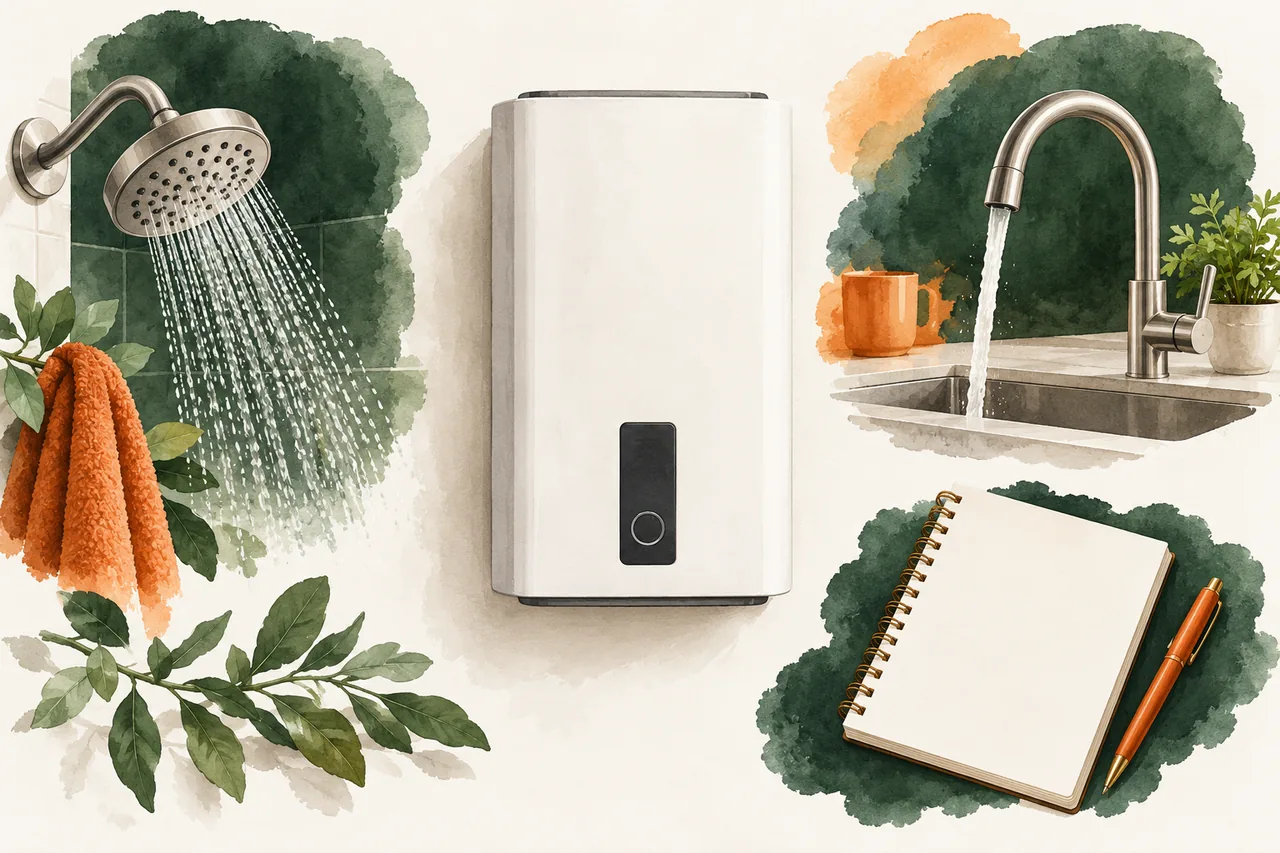
Tankless water heaters should be compared against your busiest realistic hot-water demand, not simply the largest gallons-per-minute figure in a product title. A shower running alone and several fixtures operating together are different requirements.
Start with how your household uses hot water, then ask a qualified installer to match that demand to the equipment and property.
For gas-fired models, the installation assessment belongs near the start of the buying process. The heater, fuel supply, venting arrangement, water quality and electrical needs have to work together.
A compact wall-mounted cabinet does not establish that replacing an older heater will be a like-for-like job.
Start with these three checks
- List the hot-water uses that may overlap.
- Compare flow at the required temperature rise.
- Check utilities, water quality and service access.
Tankless water heaters: compare flow at the required temperature rise
The Navien NPE-2 installation manual provides model specifications and performance curves that relate hot-water delivery to heating demand. Read a candidate’s flow performance at the inlet-water conditions relevant to your home.
A maximum flow claim without its temperature-rise conditions is an incomplete comparison.
Prepare a fixture list for the installer. Include the showers, baths and other hot-water uses that could overlap, along with the actual fixture specifications if available. Explain what you consider an acceptable restriction: perhaps laundry can wait during a shower, but two bathrooms need to work together on weekday mornings.
Ask for the sizing assumptions in writing, including incoming water conditions and the proposed hot-water delivery strategy. Have the professional account for seasonal conditions rather than sizing from a warm-weather snapshot.
Do not use a product’s headline flow as a universal promise for every climate or fixture combination.
Match the exact model to the application
Keep the complete model identifier, fuel type and intended installation location together on your comparison sheet. Similar names can refer to different versions or applications. Ask the manufacturer or supplier to confirm the model’s intended residential or commercial use rather than treating every unit in a category as interchangeable.
Check the installation documentation for the actual candidate. The Navien manual requires qualified installation and service and contains model-specific requirements for gas, water, condensate, combustion air, venting and power.
These are professional assessment items, not a DIY shopping checklist for assembling an installation.
Request a site visit before committing to equipment. Ask whether the proposed location and existing services can support the heater, what work is included and whether approvals are required.
Do not assume an existing vent or gas line is suitable because it served the previous water heater. This guide supplies no universal clearance or venting dimensions.
Separate hot-water capacity from waiting time
Tell the installer if your main complaint is the wait at a distant tap. Buying a heater with a higher flow rating does not, by itself, answer a distribution-system problem.
Ask the professional to explain the likely cause and how the proposed arrangement addresses it before paying for more capacity.
Recirculation needs an exact model and plumbing review. The NPE-2 manual distinguishes recirculation arrangements and equipment requirements. Do not assume every similarly named heater has the same pump or that a recirculation function works identically with every home’s piping.
Ask what the proposal includes, which accessories are necessary and how the controls will be handed over. Compare the complete solution to your waiting-time complaint, not an isolated feature label.
If you only need reliable service at a nearby fixture, a complicated recirculation proposal deserves a clear explanation.
Water quality and service access affect the choice
The Navien manual sets water-quality requirements and discusses maintenance and heat-exchanger flushing. Give the installer any available water-quality information and ask what treatment or service plan the exact heater requires. Do not adopt a universal descaling interval from an unrelated product review.
Ask where required service access will be maintained and who can service the model locally. Request the applicable maintenance instructions and warranty document before purchase. Clarify which work is routine owner care and which requires a qualified technician.
Keep the model, serial number and commissioning records together after installation.
Discuss cold-weather exposure and power interruptions with the installer. The NPE-2 manual describes electrical supply requirements and freeze-related limitations. Do not assume a gas-fired heater works without electricity or that built-in protection covers every exposed pipe and every loss-of-power situation.
Ask for a property-specific plan rather than improvising one during a freeze.
On a small screen, swipe or scroll the table to compare all columns.
| Compare | Record for each candidate | Decision it supports |
|---|---|---|
| Hot-water demand | Expected overlapping fixtures and required temperature rise | Whether the model fits your household’s peak use |
| Exact application | Full model, fuel and intended installation location | Whether you are comparing suitable versions |
| Installed scope | Professional assessment of services, venting and drainage | Whether the proposal is complete |
| Waiting-time needs | Distribution review and any recirculation equipment | Whether the proposal addresses your actual complaint |
| Maintenance | Water-quality review, access and service responsibilities | Whether ownership is practical at your property |
Ask for a complete proposal
Compare proposals that name the heater, required accessories, professional work, approvals and commissioning. Have the installer explain the user controls and safe temperature-management approach for your household. Do not change temperature settings to compensate for a sizing problem without professional advice about scalding risk and system suitability.
For combustion safety, maintain carbon monoxide alarms according to CPSC guidance and the alarm instructions. Then review Patioora tankless water heaters against your written specification. Confirm the exact model and current offer details; manufacturer examples here are not promises of stock, installed performance or included accessories.
Frequently asked questions
Is the highest gallons-per-minute rating the best choice?
Not necessarily. Compare performance at the required temperature rise and your overlapping fixture demand. Have the installer document those assumptions for the proposed model.
Will a tankless heater make a distant tap hot immediately?
Do not assume it will. Ask the installer to review the distribution piping and any suitable recirculation approach. More heater capacity is not a substitute for diagnosing the wait.
Can I choose a gas model without reviewing the installation?
A qualified professional should assess the property before purchase. Fuel supply, combustion air, venting, drainage and electrical requirements are model-specific and can change the project scope.