
Swing Sets & Playsets: A Backyard Planning Checklist

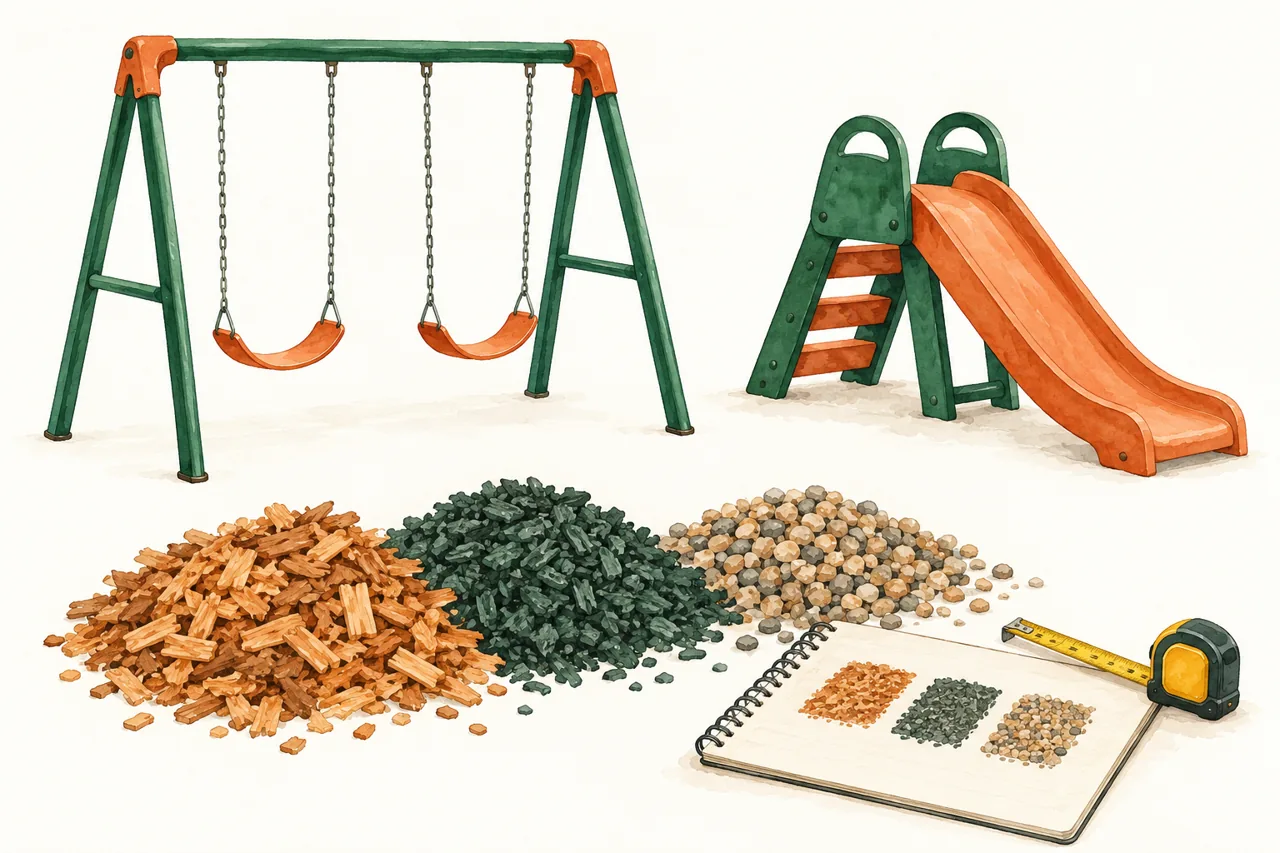
The hardest part of choosing a backyard playset is often deciding what to leave out. A larger tower or another swing may look appealing, but the useful comparison starts with the children who will use it and the whole area needed around it.
The frame’s footprint is only one part of that decision.
This guide is for families comparing residential swing sets and playsets before committing to a location. Use Patioora’s Swing Sets & Playsets category as the category destination, then obtain the exact candidate’s manual.
The planning steps below do not certify a product, approve your yard, or replace professional installation where needed.
Start with these three checks
- Check the manufacturer’s intended users and limits.
- Plan the complete play area and required surfacing.
- Read inspection and maintenance instructions before buying.
Start with the children who will use it now
Write down the intended users and their current ages, then check each candidate’s documented age and occupancy limits. Do not choose solely for a future age while overlooking whether the equipment suits the children who will use it today.
Ask about restrictions for individual activities as well as the complete set.
Describe the play you expect rather than counting accessories. One family might prioritize swinging together. Another might want climbing and pretend play. Ask which activities can be used at the same time under the manufacturer’s instructions.
A photograph filled with children is not an occupancy specification.
Include the supervising adult in the layout. Decide where you expect to stand or sit and what you can actually see from there. If a panel or tower hides an area you want to watch, ask for another view or a dimensioned drawing before assuming the design suits your supervision plan.
Compare the complete play area, not the frame
The CPSC Outdoor Home Playground Safety Handbook, publication 324 calls for protective surfacing beyond equipment and additional space in front of and behind swings. Use that distinction when asking for a manufacturer’s full use-zone drawing; do not mark out only the frame legs.
Request the drawing for the exact configuration, including the slide direction and every swinging component. Put the full area onto a site plan alongside boundaries, paths, trees, doors, and fixed structures.
Ask the installer to identify any site issue that the plan alone cannot settle.
CPSC’s home playground handbook recommends a level location and keeping the site clear of obstacles such as low branches and overhead wires. Its guidance is a reason to review the location carefully, not permission to improvise a foundation or modify the equipment to fit.
On a small screen, swipe or scroll the table to compare all columns.
| Compare | Record for each candidate | Stop and clarify if |
|---|---|---|
| Intended users | Age, occupancy, and activity-specific limits | The listing gives only a general family description |
| Complete area | Manufacturer use zone and swing clearance drawing | You have only frame dimensions |
| Protective surface | Required area, appropriate tested system, maintenance plan | The proposal assumes the lawn is enough |
| Installation | Site preparation and model-specific anchoring scope | Instructions are missing or substitutes are proposed |
| Ownership | Inspection schedule and replacement-parts access | Nobody can identify the product or manual revision |
Budget for the surface before adding another feature
A playset comparison is incomplete without surfacing. The CPSC handbook says grass and dirt are not protective surfacing, and carpeting and thin mats are generally inadequate. Do not treat a lawn photograph as evidence of an acceptable installation.
Ask the surfacing supplier or installer how the proposed system relates to the equipment’s fall height and use area. Request supporting documentation rather than accepting a generic rubber or mulch label.
CPSC’s guidance discusses ASTM F1292 test reports for manufactured surfaces and the protection height they cover.
Compare the entire proposed project: equipment, site work, surfacing, installation, and any required approvals. Leave room in your plan for the upkeep the selected materials require. If the complete project exceeds your intended spend, reconsider the playset size before treating the protective surface as optional.
This guide intentionally does not provide a universal surfacing depth or anchoring recipe. Those decisions need the actual equipment, surface documentation, and site. Give the relevant documents to the installer together so that the purchase is not based on isolated specifications.
Read the inspection page before you buy
Ask for the inspection and maintenance schedule while you still have several candidates. Decide who in the household will follow it and where the manual will be kept.
Look for a clear way to identify replacement parts and contact the manufacturer if something is missing or worn.
CPSC’s Home Playground Safety Checklist calls for checking equipment and surfacing regularly, including hazardous hardware. Use the chosen product’s schedule and instructions to turn that general expectation into an ownership routine.
Keep a simple record of the model, purchase documents, manual revision, and any manufacturer-approved changes. If you move house or pass the set to another owner, those documents matter more than your memory of how it was assembled.
Do not substitute a similar model’s parts list because the frames look alike.
Keep upgrades separate from improvisation
Before purchasing a replacement seat or an extra accessory, ask the manufacturer whether it is approved for the exact set. Do not assume a component will work because a connector appears to fit.
Make compatibility a written question, particularly if a proposed change affects how children move through the play area.
The CPSC checklist warns against attaching ropes, jump ropes, clotheslines, or pet leashes because of strangulation hazards. Keep unrelated household play items out of accessory experiments and teach children the equipment’s intended use.
- Match the documented age and occupancy limits to current users.
- Obtain the complete use-zone drawing, not just frame dimensions.
- Resolve surfacing, site preparation, and anchoring before ordering.
- Read the inspection routine and confirm parts support.
- Request written compatibility for any proposed accessory.
Bring that checklist to the Swing Sets & Playsets category. Choose the set whose complete installation and care plan you can support, even if that means fewer activities on the frame.
Frequently asked questions
Is a lawn an adequate protective surface?
CPSC’s home playground handbook does not consider grass or dirt protective surfacing. Resolve a suitable surface for the selected equipment and use area before buying; do not rely on the surface shown in a promotional photograph.
Can I use the frame dimensions to decide whether it fits?
No. Request the manufacturer’s complete use-zone information, including clearances for swings and other moving activities. Compare that area with the site and have unresolved installation questions assessed before ordering.
Should I buy a larger set for children to grow into?
First establish that the equipment suits its intended users now. Compare documented age and activity limits, the available complete area, and the maintenance commitment. Future usefulness should not override current suitability.