
Grill, Griddle or Smoker? Choose for Your Meals

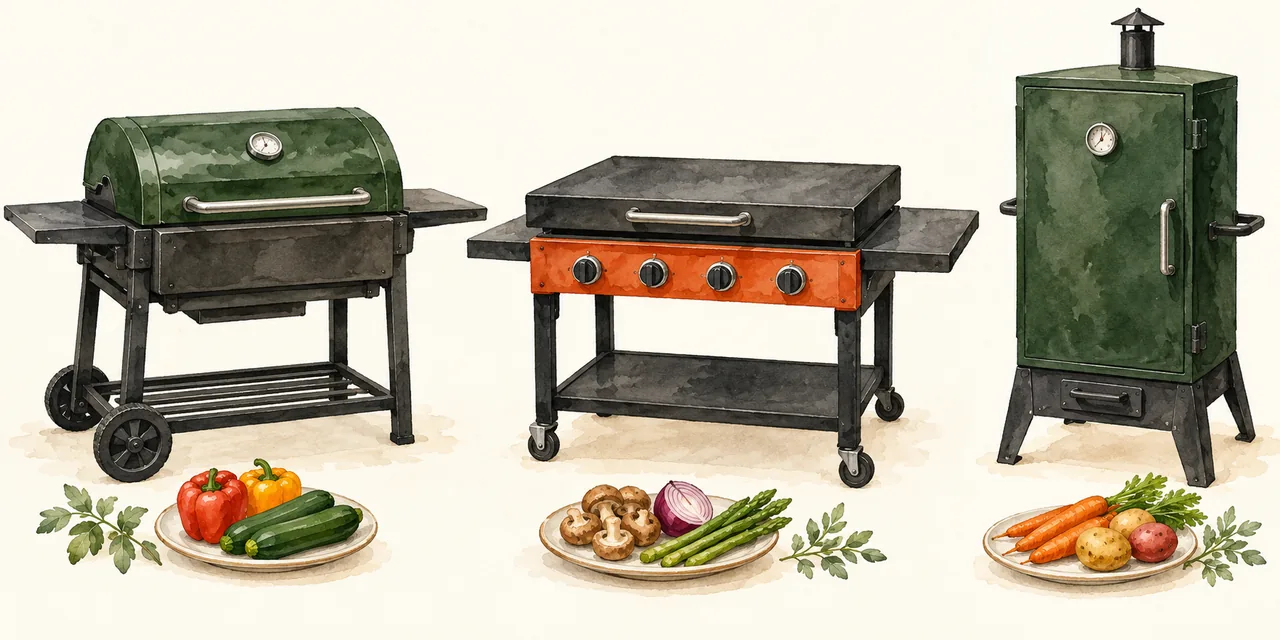
The best starting point for choosing a grill, griddle, or smoker is last week’s meals. If you mostly wanted breakfast outside and quick sandwiches, a flat cooking surface deserves attention.
If the meal you keep planning is a long weekend barbecue, compare smoking features first. Buying every cooking method in one cart can make sense, but only if you expect to use each part.
Use this guide to make a menu-led shortlist from Patioora’s Grills, Griddles & Smokers category. It is a comparison framework, not a claim that any particular appliance is available or that we have tested it.
Confirm the exact model, fuel configuration, and manual before deciding where it will go.
Start with these three checks
- Choose the meals and cooking methods you use most.
- Check usable cooking space and fuel requirements.
- Confirm the location and cleaning routine.
Choose the meal before the machine
List five meals you genuinely want to cook outdoors. Beside each, write whether your priority is a continuous flat surface, a cooking grate, or a documented smoking mode.
Then add the time you are willing to spend preparing and cleaning the appliance. Give the ordinary Tuesday dinner as much attention as the occasional party.
For breakfast, picture where eggs, pancakes, and a spatula will sit. For burgers, think about how you want to cook them and where finished food will wait. For a slow barbecue, think about how you will monitor the cook and remain available throughout it.
These are useful questions even before you compare dimensions.
A combination unit deserves a separate sketch. Imagine using both cooking sections at once, with their lids or doors open. Where will you stand? Can someone bring a tray without crossing your workspace?
Do you want two active cooking tasks, or would you prefer one appliance you can learn thoroughly?
On a small screen, swipe or scroll the table to compare all columns.
| Your priority | What to investigate first | What to verify on the model |
|---|---|---|
| Breakfast and flat-surface meals | A griddle with a workable preparation area | Cooking-surface material, care instructions, grease access |
| Meals centered on grate cooking | A grill whose layout suits your pans and food | Usable main grate, heat controls, lid clearance |
| Planned smoking sessions | A smoker or pellet grill with documented controls | Fuel, power, monitoring, cleaning, shutdown procedure |
| Two different cooking jobs together | A combination appliance | Independent controls, simultaneous use, access to both sections |
Separate fuel from electrical requirements
Fuel labels do not tell you everything about utilities. Traeger explains that its pellet grills burn hardwood pellets while using electricity for components including the controller, auger, ignition, and fan. A pellet-fired appliance can therefore still need a suitable electrical supply.
Write down the actual requirements from each candidate’s manual, rather than assuming a familiar brand name means the same configuration. Ask the supplier to confirm whether the unit is supplied for the fuel you have.
If a conversion is proposed, require written manufacturer support for the exact model and arrange qualified work where required. This guide is not a gas-connection or conversion procedure.
Plan where fuel and accessories will live, but use the selected appliance’s instructions for storage and operation. If your preferred location depends on running a cable through a doorway or placing the appliance under a roof, resolve that issue before comparing optional gadgets.
Do not redesign a safe location around a purchase already made.
Compare usable cooking space, not just a total
Ask for the dimensions of the main cooking surface and each secondary rack separately. A large combined area does not explain whether the pan you use will fit where you need it.
Take the dimensions of your usual cookware to the comparison, and request a drawing if the listing is unclear.
For a combination cart, keep the areas separate on your worksheet. Your decision is whether the individual sections suit the meals you identified, not whether their sum looks impressive.
Record whether shelves fold, where controls sit, and how you reach the grease collector. Put open-lid and open-door dimensions beside the closed footprint.
Consider serving space as its own requirement. A shelf that holds utensils may not be the place you want to put a platter. Try a paper layout with your normal tray dimensions.
That small exercise can reveal whether you need a separate preparation table more urgently than a larger cooking surface.
Buy the cleaning routine you will actually follow
Read the maintenance section before purchasing. Blackstone’s model 1554 owner’s manual, care and seasoning section describes seasoning its steel cooking surface as an ongoing process. That is a particular care routine, not evidence that every flat-top appliance has the same surface or preparation requirements.
The same manufacturer manual describes washing, thoroughly drying, and lightly oiling the surface before storage. When comparing appliances, ask what the manufacturer expects after an ordinary meal and what supplies you need to keep nearby.
This reference manual is not a specification for an unidentified griddle.
For another type of cooker, request the equivalent instructions for grease, ash, racks, and shutdown. Avoid assuming that one brand’s cleaning method suits another finish. Put access on your checklist: can you reach the parts the manual asks you to clean without moving the cart into an inconvenient position?
Approve the location before the purchase
CPSC’s grilling guidance says to use grills outside in well-ventilated areas, not indoors, in a garage, breezeway, carport, porch, or under a surface that will burn. A patio structure is not automatic permission to cook beneath it.
The NFPA grilling safety sheet also calls for keeping grills away from the home, railings, eaves, and branches, and never leaving them unattended. Use the exact appliance instructions and applicable local requirements to approve your proposed location.
- Match the primary cooking method to meals you expect to make regularly.
- Confirm fuel, electricity, permitted location, and open-appliance dimensions.
- Request separate measurements for main and secondary cooking areas.
- Read cleaning and shutdown instructions before comparing extras.
- Resolve installation questions with the manufacturer and a qualified professional.
Use the category page to compare documented candidates against that list. A smaller shortlist makes room for a better question: which appliance suits the way you will cook most often?
Frequently asked questions
Should my first outdoor cooker be a griddle or a smoker?
Choose around your regular menu and the time you want to spend cooking. Give a flat surface priority if that is what your meals need; investigate smoking equipment first if planned smoking sessions are the main reason for buying.
Does a pellet grill need electricity?
Traeger’s explanation describes electricity powering operating components while pellets fuel the fire. Check the chosen model’s manual for its actual supply requirements instead of treating pellet fuel as evidence that no outlet is needed.
Is a combination cooker always better value?
Only if both sections solve useful jobs for you. Compare each section’s usable size, access, controls, and maintenance separately. Do not pay for an extra cooking method without deciding when you expect to use it.